
Welcome to the Student Support Centre and SEND Department at Torpoint Community College
At Torpoint Community College, we are committed to creating an inclusive environment where all students can access, engage with and succeed in the mainstream curriculum. We recognise that barriers to learning arise from the interaction between a student and their environment, and we work proactively to identify and remove these barriers so that every student can participate, achieve and thrive.
High-quality adaptive teaching is the foundation of our provision and is available to all students. Through our graduated response, we provide additional support where required, ensuring that students receive the right support at the right time through a combination of universal, targeted and specialist approaches.
We use our Inclusion Access Framework to identify and monitor barriers to learning and participation. Information about students’ strengths, needs and effective support strategies is captured through Student Passports and shared with staff to promote consistent and effective practice across the school.
Our Inclusion Team works closely with students, families, staff and external professionals to ensure support is personalised and responsive to individual needs. This may include support for special educational needs and disabilities (SEND), social, emotional and mental health needs, attendance barriers, medical needs and successful transitions through school.
We believe that inclusion is everyone’s responsibility and that every student should experience a sense of belonging, make sustained progress and be well prepared for their next stage of education, employment or training.
Contact Information:
Student Support Centre: Mrs Helen Wetton
Wetton.H@torpoint.cornwall.sch.uk
SENDCo: Chloe Turner
Turner.C@torpoint.cornwall.sch.uk
Ethos and Values
At Torpoint Community College, we believe that every student can succeed when provided with the right support, opportunities and level of challenge. We are committed to creating an inclusive culture where all students feel safe, valued and able to participate fully in school life.
We recognise that students learn in different ways and may experience a range of barriers to learning and participation. Our role is to identify and remove these barriers, enabling every student to access the curriculum, develop independence and achieve their full potential.
High-quality adaptive teaching is the foundation of our provision. We maintain high expectations for all students and believe that challenge, combined with appropriate support, helps learners to develop confidence, resilience and a positive attitude towards learning.
We work closely with students, families and external professionals to ensure that support is responsive, evidence-informed and tailored to individual needs. Our aim is that every student experiences a sense of belonging, makes sustained progress and is well prepared for their next stage of education, employment or training.
What Supports Students To Succeed?
Students are most successful when they:
- Feel safe, valued and included within the school community
- Attend school regularly and engage positively with learning
- Develop resilience when faced with challenge
- Have opportunities to practise and apply new learning
- Receive the right balance of support and independence
- Experience high expectations from staff
- Build confidence and self-belief
- Access a broad curriculum and wider enrichment opportunities
Creating an Inclusive Learning Environment
We aim to provide learning environments that are calm, predictable and supportive of all learners. This may include:
- Clear routines and expectations
- Adaptive teaching and appropriate scaffolding
- Visual supports and adapted resources where required
- Positive behaviour approaches
- Thoughtful classroom seating arrangements
- Access to quieter spaces when needed
- Structured support during unstructured times
- Opportunities for every student to participate and contribute
Focus Areas For T&L For SEND Students
- To ensure that we are research-informed and use up to date evidence from experts to inform our approaches – we must be flexible to change if evidence suggests there are more effective ways of working
- To understand the reasons some students struggle to read and apply consistent approaches in every subject that improve their reading
- To understand the constraints of working memory and consistently apply approaches that enhance learning despite these difficulties
- To ask effective questions when working with students
- To have consistent approaches to supporting students/ having high expectations of them when they are required to write
- To ensure the work students produce is always a reflection of their own understanding and knowledge – we never over support so that the teacher makes inaccurate inferences about progress
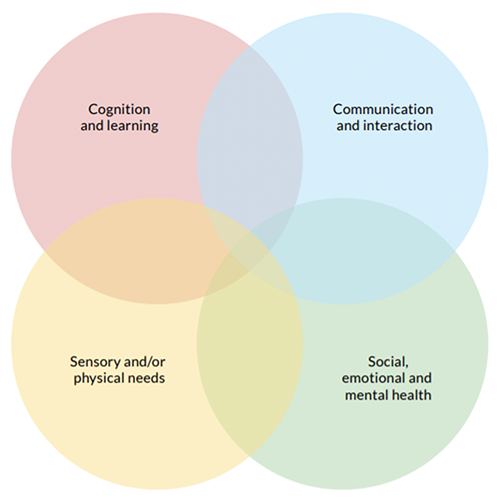
The SEND Code of Practice groups needs into four broad areas to support schools to plan the provision that they offer:
- cognition and learning;
- communication and interaction;
- social, emotional, and mental health; and
- sensory and physical needs.
Creating an inclusive environment is the most important thing a school can do. An inclusive culture is a prerequisite for an effective school: it brings happiness, a feeling of safety and being part of the community, and, of course, it impacts positively on learning, both in the classroom and beyond. It is our job to prepare pupils to flourish and feel truly included in society.
Positive environmental factors for students with SEND:
- Calm and quiet
- Can easily see the teacher when they are talking
- Can easily see the board
- Have adult-supervised spaces during unstructured time
- Be proactive and positive in managing behaviour: reward good behaviour; use positive reinforcement to deliver verbal corrections; normalize compliance
- Find ways to support maximum participation…
Scaffolding and Independence
Scaffolding refers to the temporary support provided to help students successfully access learning. This support may be visual, verbal, written or practical and is carefully matched to individual need. As students develop confidence and competence, support is gradually reduced to promote independence and ensure that learning outcomes accurately reflect students’ own understanding and progress.
SEND Linked Documents and Further Information
The SEDIASS service provides impartial advice, support and guidance for:
- Parents /carers of a child or young person (aged 0-25) with a special educational need or disability.
- Children and young people aged 25 or under who have a special educational need or disability.
- People working with children or young people with a special educational need or disability.
Their service is confidential, independent and free.
You can contact them via https://www.cornwallsendiass.org.uk
Cornwall Local Offer:
Cornwall’s Local Offer is an information point for families of children and young people with special educational and disabilities (SEND). Find out what services are available and how to access them. For example:
- The Education, Health and Care (EHC) assessment and planning process
- Support for young people preparing for adulthood
- Education, health and social care
- Childcare
- And much more, including a range of services from within the public, private and voluntary sectors
Visit Local Offer website: SEND Local Offer – Cornwall Council
SEND information